
Over the summer, Sarah Said (@MrsSaid) and I put together an #EllChat_BkClub
round focused on using the app Flipgrid for English learners. Flipgrid asked us
to share some of our takeaways, so we wrote this blog post detailing the benefits
of using Flipgrid to support English learners. Thanks to all the amazing educators
who chimed in and contributed ideas!
round focused on using the app Flipgrid for English learners. Flipgrid asked us
to share some of our takeaways, so we wrote this blog post detailing the benefits
of using Flipgrid to support English learners. Thanks to all the amazing educators
who chimed in and contributed ideas!
Flipgrid is a great tool for capturing student voice, which is one of many reasons we
selected it for one of our #EllChat_BkClub technology rounds on Twitter. Typically
#EllChat_BkClub chats are focused on reading books that help us (language
teachers from across the globe) improve our instructional practices for English
learners. Then, Sarah had the idea to add a focus on technology into the mix since
devices and educational technology are so prevalent in today’s classrooms. In
between our book chats, we organize chats around particular apps, specifically how
they benefit English learners and language development in the four language
domains; reading, writing, speaking, and listening. We posted the following 5
questions and asked participants to join the chat using #Flipgrid4ELs.
selected it for one of our #EllChat_BkClub technology rounds on Twitter. Typically
#EllChat_BkClub chats are focused on reading books that help us (language
teachers from across the globe) improve our instructional practices for English
learners. Then, Sarah had the idea to add a focus on technology into the mix since
devices and educational technology are so prevalent in today’s classrooms. In
between our book chats, we organize chats around particular apps, specifically how
they benefit English learners and language development in the four language
domains; reading, writing, speaking, and listening. We posted the following 5
questions and asked participants to join the chat using #Flipgrid4ELs.
Over the course of about a week, we had many teachers participate and offer
some great insights around the power of using Flipgrid for the benefit of English
learners.
some great insights around the power of using Flipgrid for the benefit of English
learners.
Check out some of the comments:
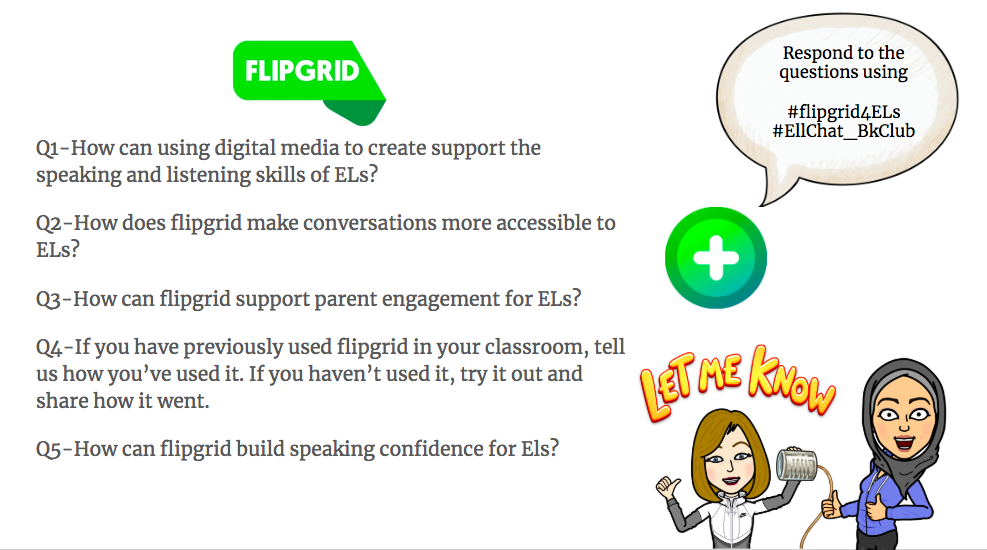
Q1: How can using digital media to create support the speaking and listening
skills of ELs?
skills of ELs?


Q2: How does Flipgrid make conversations more accessible to ELs?


Q3: How can Flipgrid support parent engagement for ELs?


Q4: If you have previously used Flipgrid in your classroom, tell us how you
used it. If you haven’t used it, try it out and tell us how it went!


Q5: How can Flipgrid build speaking confidence for ELs?


Some of the main discussion points reflect that Flipgrid allows students sufficient
time to process, plan, and think about what to say. All of these elements are very
important for students who are learning a new language and likely processing
information in both their native language and English. It also provides opportunities
for students to record their language, listen to what they said, stop, go back, and
listen again in order to ensure they are happy with how their recording comes out.
Listening to their own language production affords English learners opportunities
notice areas where they can improve and also gain confidence.
In our live chat, we discussed how to overcome the barrier of students who are
shy or not comfortable being recorded on camera, such as middle and high
school students who might have concerns over their appearance. We brainstormed
ideas to support students with those concerns such as offering silly glasses,
masks, or photo booth type props they could use to conceal their faces while
they speak. We also chatted about how when students frequently use technology
to record their spoken language and learn how to listen to their own speech to
evaluate their volume, clarity, grammar, etc., they are better prepared for
standardized language assessments that involve voice recordings. For one of
my students who is very soft spoken and shy, the quality of her recordings on
ELPA21 in Kindergarten resulted in a level 4 for speaking because she routinely
recorded on her iPad in class leading up to the test, yet her score dropped to a
2 in first grade because she was not engaging in the same practice with digital
recordings and didn’t have the same confidence as she did the year prior.
school students who might have concerns over their appearance. We brainstormed
ideas to support students with those concerns such as offering silly glasses,
masks, or photo booth type props they could use to conceal their faces while
they speak. We also chatted about how when students frequently use technology
to record their spoken language and learn how to listen to their own speech to
evaluate their volume, clarity, grammar, etc., they are better prepared for
standardized language assessments that involve voice recordings. For one of
my students who is very soft spoken and shy, the quality of her recordings on
ELPA21 in Kindergarten resulted in a level 4 for speaking because she routinely
recorded on her iPad in class leading up to the test, yet her score dropped to a
2 in first grade because she was not engaging in the same practice with digital
recordings and didn’t have the same confidence as she did the year prior.
Many teachers are diving into the #flipgridfever movement and realizing how fun
and engaging it is for students to use, but we are particularly excited about its
potential as a wonderful tool for English learners. If you’re interested in trying it
out, but you’re not sure where to start, Flipgrid offers some great resources to
help teachers out. The e-book and teacher guide offer ‘how to’ information and
there is also a disco library provides a variety of activity templates created by
teachers, which are organized by audience, topic/subject, and topic goals.
Within this database, there is a category of activity templates for language learning.
These templates can provide teachers with pre-created assignments or they can
serve as inspiration by showing teachers how they can structure assignments in
ways that support English learners. Also, don’t forget to search #FlipGrid4ELs for
additional ideas about how and why Flipgrid is great for your ELs.
potential as a wonderful tool for English learners. If you’re interested in trying it
out, but you’re not sure where to start, Flipgrid offers some great resources to
help teachers out. The e-book and teacher guide offer ‘how to’ information and
there is also a disco library provides a variety of activity templates created by
teachers, which are organized by audience, topic/subject, and topic goals.
Within this database, there is a category of activity templates for language learning.
These templates can provide teachers with pre-created assignments or they can
serve as inspiration by showing teachers how they can structure assignments in
ways that support English learners. Also, don’t forget to search #FlipGrid4ELs for
additional ideas about how and why Flipgrid is great for your ELs.



