Family

My school district uses Journeys as the adopted reading curriculum and lesson 1 for Kinders is about families. This is a great opportunity to be "community responsive" because all families are different and that needs to be normalized.  I heard the term community responsive at an equity training and I really like it. It's a different way of saying culturally responsive, perhaps with a broader lens because by focusing on the needs of your community (your students/your class) you can connect to culture and more. It is yet another way of affirming that we need to know our students and make sure they are represented in our curriculum and our lessons. We took time in this lesson to talk about, and celebrate, that one student just got a new baby sister at home. That is exciting and should definitely be part of this lesson on family! I asked her some questions and she answered (this is an EL student) so that was great language practice! 

Reading the main selection and any other texts related to the theme does not take place during my co-taught language lessons. Kinder teachers read the stories at different times. My lesson reinforce language around the lesson's theme. 

Today we sang and talked about our families. 

I introduced all the family words with "my turn/your turn." This is also a great time to acknowledge ways to say these words in other languages, but I did say we were using certain words for our partner talk. Mommy is fine, but for today, we said "mother."

 The song is to the tune of Do You Know the Muffin Man.

We practiced putting different family members in the blank and singing the song. {family member cutouts are from National Geographic Reach curriculum}. The song format provides students multiple opportunities to say the target family member word because it repeats 5 times. 

I have a sister a sister a sister. I have a sister and my sister loves me. 

During our lessons we do a few things to reinforce positive behaviors. 1) We pull equity sticks and give students opportunities to be the helpers. Our rule is that if we pull a stick and a student looks like a PAX leader (PAX is our positive behavior system), then they can come be a helper. This helps keep students engaged because at this age, they want to be called on to help. If a student is not showing expected behaviors when the stick is pulled, we will choose a different one. 2) We play the "secret student" game. My co-teacher pulls a stick and doesn't reveal the name. She watches that student during the singing to see if he/she is participating. If they are, they get a PAX ticket (students collect those to buy prizes as part of a school wide PBIS system). Both of these help students focus on positive behaviors and encourages all students to practice the language. 

After I had multiple helpers choose family members so we could practice the song with all different family member names, we (the two teachers) modeled partner practice by sharing who is in our families. We demonstrated "popcorning" back and forth so we each got to share several people. We modeled using the sentence frame from the song: I have a _____. 

We also gave a challenge frame: I have a ____ named ____ . Students could choose to try that if they wanted to.

We taught specific expectations for partner practice earlier in the week using this TALK poster. Today, prior to having them turn and talk, we reviewed our TALK expectations poster. We assign students to partners and also assign them as cookies and milks. Those partnerships change, but stay consistent from lesson to lesson for a decent amount of time. We are careful in planning partnerships to make sure students will work well together. 


For our very beginner students, I typically take a photo of my pocket chart and print it in color so that they can have personal images to use during partner talk. This helps to facilitate the target language or provides them an opportunity to point if they are not yet confident in the target language. We only use personal visuals for students who really need them. Otherwise, we expect students to use the pocket chart visuals and the language to express their ideas. 


Following partner practice, students drew a picture of their family and labeled the different family members. 


Lesson Details: 

Content Objective: I can name family members

Language Objective: I can tell who is in my family.

Language Function:  Describe people

Language Form:
nouns
proper nouns (if family members are named)
number adjectives

Sentence Frame(s):
Teacher: Who is in your family?

Students: 
_____ (mom, dad, sister)

My _______.

My _______is in my family.

I have a _____.

I have a ____ named _____.

I have {number} ____s. 


As a follow-up to this lesson, teachers will also teach a lesson about what students can do with their families. I will not co-teach this lesson with classroom teachers, but we planned it together and I am providing the materials. 


The cards pictured are What's Happening? Photo Cards from Lakeshore Learning.

The language in this lesson is a little more open-ended (students will come up with the verbs to describe what they do with their families/what is happening in the photos). This is a great opportunity to hear a little more about their own experiences. Students will do a piece of writing that uses this sentence frame and they will illustrate what they like to do with their family. They can try to sound out the word and write it (the words in the frame are printed on the page already) or the teacher can listen and write the students idea. 



Cafeteria Language

Everything about school can be overwhelming for our littlest learners, so one lesson I like to do at the beginning of the year with Kinders is cafeteria language. We cover how to ask for help and also how to order lunch. 

The first part is teaching the different hand signals that indicate different needs. I took photos in our actual cafeteria and then paired them with visuals of the hand signals they need to use for each request. But, I also want to encourage students to use language and not just hand signals, so each picture/signal is paired with a question.


I use this song to introduce how we need to use please and thank you and then I used the same tune for the questions associated with each cafeteria need. Some people might dislike the use of "can I" instead of "May I" but the video uses "Can I" so I just stuck with that. Kiddos love this video and then it helps provide some musical styling for working on saying those challenging questions!


After we watch the video, we (the teachers) will role play (remember these are co-taught lessons), asking for help in the cafeteria using manners. With students, we will practice singing the questions and saying thank you, modeling after the video.

The next part of the lesson will be teaching students how to order hot lunch. Using some of the same food images as we used in our Pete the Cat lessons {food pics & more food pics}, we will model and how to tell the lunch lady what we'd like for lunch. We role play examples and non-examples so students can get an idea of what they need to do:

Use a "3 foot voice"
Say the name of the food they want
Use manners (please and thank you)

We use the same tune from the video to model a complete sentence: Can I have the ___ please? At this point we are perfectly ok with students pointing to their food choice or simply saying ___ please, but we also teach and encourage students to use a complete sentence if they can.

We also use play food and real cafeteria trays to practice. We check in by pulling sticks to select random students and having them come up to the front and make a food choice. Then we ask the rest of the students to give a thumbs up/thumbs down to show whether or not the student did all of the things we practiced. 

Language Objectives:
I can say please and thank you when I ask for help.
I can say what I want to have for lunch.

Language function
Express needs, likes, and feelings
Express social courtesies 

Language form: nouns (naming the food items)

Sentence Frame

______ please  (newcomers/beginners)

May I have the ____please?

Can I use the bathroom please?

Can I dump my trash now please?

Can you help me open this please?

Can I get a drink of water please?

Target words: 
please, thank you 


Kicking off Co-Teaching in K

I have not been at all good about keeping up with this blog, but since a few people have asked for the resources I used for my Pete the Cat lesson,  I thought I would create a post with the links and info.


This image shows how I prep all my materials for co-taught lessons. I get everything ready in a pocket chart that is pinned to my wall. When it's time for the lesson, I simply grab the pocket chart and go! In each classroom where I co-teach I have a place to hang the charts I bring (usually over the classroom teacher's chart) and then I carry them away with me when I leave. 

The images I used for this lesson can be found here:


I did not use all the food images, just selected what I thought my students might like and foods that represent different colors.

Prior to doing this co-taught language lesson, classroom teachers read:


Content Objective: I can recognize colors.

Language Objective: I can use color words to describe Pete’s shoes.

Language Function: describe people and things

Language Form: color adjectives

Sentence Frame(s):
Pete stepped in a big pile of ________.

I love my _____ shoes. 

This is a really fun lesson to review/teach color words  as well as foods. It's also fun to get a little silly singing along to the tune from the book. If you can access this story as an audio book, it's great to listen to.

We typically choose sticks to select students as helpers. Helpers get to choose a food. Then we use a a  response signal that incorporates think time and have the whole class respond with what color that food will turn Pete's shoes. 

Then we sing using the frame: I love my {color} shoes!

I plan to bring a blow up guitar and also my great karaoke microphone, which the kiddos love to speak into. 

Let me know if you try this with your students too! Kinders sure do love Pete the Cat! 


Using Flipgrid to Support English Learners

Over the summer, Sarah Said (@MrsSaid) and I put together an #EllChat_BkClub
round focused on using the app Flipgrid for English learners. Flipgrid asked us
to share some of our takeaways, so we wrote this blog post detailing the benefits
of using Flipgrid to support English learners. Thanks to all the amazing educators
who chimed in and contributed ideas!

Flipgrid is a great tool for capturing student voice, which is one of many reasons we
selected it for one of our #EllChat_BkClub technology rounds on Twitter. Typically
 #EllChat_BkClub chats are focused on reading books that help us (language
teachers from across the globe) improve our instructional practices for English
learners. Then, Sarah had the idea to add a focus on technology into the mix since
devices and educational technology are so prevalent in today’s classrooms. In
between our book chats, we organize chats around particular apps, specifically how
they benefit English learners and language development in the four language
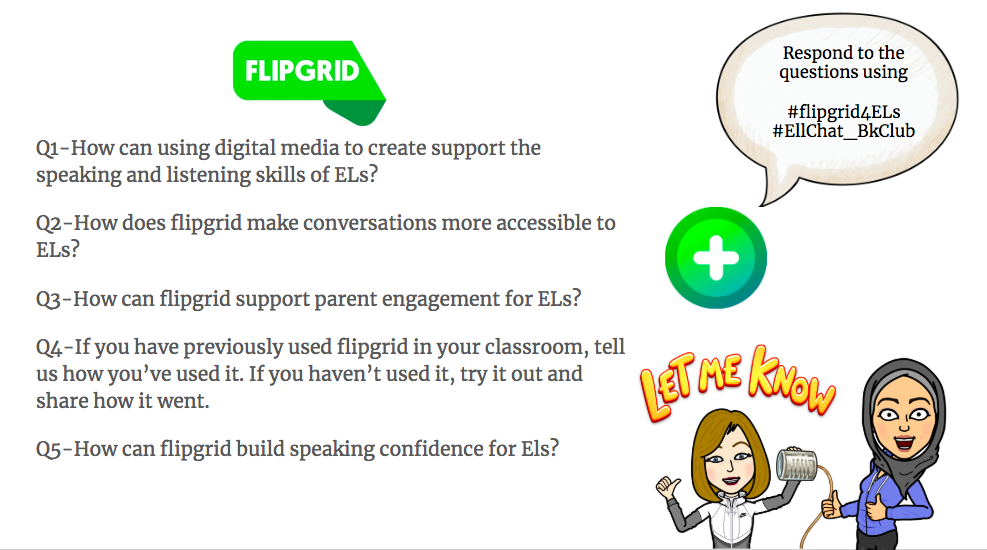
domains; reading, writing, speaking, and listening. We posted the following 5
questions and asked participants to join the chat using #Flipgrid4ELs.


Over the course of about a week, we had many teachers participate and offer
some great insights around the power of using Flipgrid for the benefit of English
learners.

Check out some of the comments:


Q1: How can using digital media to create support the speaking and listening
skills of ELs?

Q2: How does Flipgrid make conversations more accessible to ELs?


Q3: How can Flipgrid support parent engagement for ELs?

Q4: If you have previously used Flipgrid in your classroom, tell us how you
used it. If you haven’t used it, try it out and tell us how it went!


Q5: How can Flipgrid build speaking confidence for ELs?


Some of the main discussion points reflect that Flipgrid allows students sufficient
time to process, plan, and think about what to say. All of these elements are very
important for students who are learning a new language and likely processing
information in both their native language and English. It also provides opportunities
for students to record their language, listen to what they said, stop, go back, and
listen again in order to ensure they are happy with how their recording comes out.
Listening to their own language production affords English learners opportunities
notice areas where they can improve and also gain confidence.

In our live chat, we discussed how to overcome the barrier of students who are
shy or not comfortable being recorded on camera, such as middle and high
school students who might have concerns over their appearance. We brainstormed
ideas to support students with those concerns such as offering silly glasses,
masks, or photo booth type props they could use to conceal their faces while
they speak. We also chatted about how when students frequently use technology
to record their spoken language and learn how to listen to their own speech to
evaluate their volume, clarity, grammar, etc., they are better prepared for
standardized language assessments that involve voice recordings. For one of
my students who is very soft spoken and shy, the quality of her recordings on
ELPA21 in Kindergarten resulted in a level 4 for speaking because she routinely
recorded on her iPad in class leading up to the test, yet her score dropped to a
2 in first grade because she was not engaging in the same practice with digital
recordings and didn’t have the same confidence as she did the year prior.

Many teachers are diving into the #flipgridfever movement and realizing how fun
and engaging it is for students to use, but we are particularly excited about its
potential as a wonderful tool for English learners. If you’re interested in trying it
out, but you’re not sure where to start, Flipgrid offers some great resources to
help teachers out. The e-book and teacher guide offer ‘how to’ information and
there is also a disco library provides a variety of activity templates created by
teachers, which are organized by audience, topic/subject, and topic goals.
Within this database, there is a category of activity templates for language learning.
These templates can provide teachers with pre-created assignments or they can
serve as inspiration by showing teachers how they can structure assignments in
ways that support English learners. Also, don’t forget to search #FlipGrid4ELs for
additional ideas about how and why Flipgrid is great for your ELs.

Sometimes you pause the test


This morning I tested one of our newcomers who recently moved from Guatemala. 

She is in first grade. 

As I pointed to images of animals and body parts, she quietly thought, clearly reaching into the depths of her brain to come up with the word, then shook her head each time I asked "what is this?" because she didn't know the English words. 

As we began the section where she needs to repeat what I say, she started off okay, repeating "good morning" and trying to repeat "I'm hungry." Then, when I got to some phrases with 4-6 words, she hesitated and tears began to form in her eyes.

She felt like a failure.

I could have just continued on with the test given that I had a lot of other things to do and it was pretty clear that she was struggling.  Sometimes we feel like these tests are just something we have to to get through. But, I saw this little human, feeling badly and I had to stop. 

I looked at her and in my best Spanish, I told her that I know this is hard, but that it's okay because she is just starting to learn English. I acknowledged what she was feeling and then...

She blew me away.

She told me she actually speaks two languages in Guatemala...Spanish and K'iche'. So, English is actually her THIRD language and she is just six years old. She shared that she still has family living in Guatemala and has two cousins locally, one that attends our school. We talked about which family members speak which languages and I told her that when I moved to Germany I didn't understand anybody and I also felt bad about it, but little by little I learned. 

When we resumed the test, she read several words in English! At that point I told her very enthusiastically that I think she is the smartest girl in the world because she can speak two languages already AND she can read words in English. 

And she smiled. 

Really big. 

When we got to the section where I read a story accompanied by 4 images and then asked her to retell what happened, she retold the story in entirely in Spanish. I wrote down "response in Spanish" on the answer sheet because an answer with no English words gets a 0. Then, I reconsidered. 

She is not a 0. 

I told her I wanted to write down all of the words she said, but since I would be writing in my second language I needed her to speak slowly. She ever so slowly enunciated each word, stretching them out into syllables so I could write it all down.

ma-ri-po-sa
za-pa-to

We came to a word that I didn't know so I asked her what it meant and she explained it so that I understood it meant barefoot. I took off my ballet flat and pointed to my bare foot and she nodded. I asked her if she might want to be a teacher when she grows up because she's was very patient with me and she said yes, she might like that. 

This entire interaction made me think about the purpose of assessment. 

I could have told you prior to administering this test that she would be a beginner, but giving this test was an opportunity.

An opportunity to build a relationship.

An opportunity to make a worried child understand she is not alone.

An opportunity to make a sweet student smile.

An opportunity to learn a new word in Spanish.

An opportunity to learn more about a student new to our school. 

An opportunity to inspire a future teacher. 

After this interaction, I excitedly shared with several colleagues about how special this girl is. I thought a lot about Emily Francis and her story. I thought about so many other stories I've read or heard from students who felt so alone and felt badly about themselves when they first came to the U.S. and didn't know English yet. 

I really hope that today becomes part of this girl's story. I hope that when she thinks about her first week at school she remembers me and what I said. I hope she realizes how much power there is in being multilingual and how SMART she is. 

I hope she knows.

Engage

One element we focus on in teaching is keeping students engaged. 

Engagement is huge. 

For #EllChat_BkClub on Twitter, we are currently reading the book EL Excellence Every Day by Tonya Ward Singer, which includes an entire section called "Engage" that offers valuable information on keeping learners, particularly English learners, engaged. 

Tonya breaks engagement down like this: 


  • Interest-Wow. This is fascinating. I love this! Cool.
  • Sense of purpose-I want to learn this because I understand why it is important.
  • Relevance-This is relevant to me. I see myself in this goal.
  • Connection-This reminds me of...This is similar to...
  • Choice-I choose this book because...I want to write about...I want to create...
  • Curiosity-I wonder....? What will happen if...?
  • Self-efficacy-I know I can do this. To move closer to that goal, I'll try...

I want to take a moment to flip the context. 

Let's talk about professional development. 

I would argue that engagement is just as significant when it comes to teachers in the role of learners. 

But, how often do experience interest, a sense of purpose, relevance, connection, choice, curiosity, and/or self-efficacy when it comes to our PD? Surely, it's different for everyone across different contexts, districts, states, even countries. The extent of our engagement may shift depending on the time of the year, the topic at hand, what is happening in our personal lives, our group of students and many other factors. 

But ultimately, are we more engaged or disengaged when it comes to PD that is provided to us within our contexts? 

Are we recharged and motivated by our colleagues or drained by negativity and the "one more thing" mentality that overtakes the authentic desire to learn?  

Are we subjected to one-size-fits-all when it comes to the latest initiative we learn about or are we flying our own plane when it comes to our personal and professional development? 

I recently read the book Future Driven by David Geurin and some of my favorite quotes were: 

"Don't expect your school to own your personal growth."

and
"Ultimately, it is your responsibility to be a learner."

I love these sentiments because they really embody what I think about professional development. 

I want to be fully engaged in my own learning and that necessitates the same things Tonya focuses on with regards to student learning. 

Interest
Sense of purpose
Relevance
Connection
Choice
Curiosity
Self-efficacy

 I am not at all intending for this to be a shameless plug for #EllChat_BkClub, but I truly think our little book chat has gained popularity because it represents these elements of engagement. 

We have a sense of purpose because we are focusing on professional knowledge and skills that will best contribute to the success of our students. 

Not any students, but OUR students. 

The ones who we share our classroom with daily. 
The ones we pour ourselves into
The ones who are on our minds constantly
who sometimes keep us up at night
bring us tears of sadness, joy, pride
who are the reasons we do what we do
who are our WHY

There's relevance for you!

We feel engaged because we are choosing to be part of this phenomenal PLN.

We are interested because we are choosing what we learn about and what books we read.

We feel connected because we are surrounded with greatness, enthusiasm, and a thirst for knowledge that is often found within one another.

We are curious to learn about the experiences of other teachers, leaders, and coaches in settings that are different than our own. 

Sometimes when I speak highly of Twitter as a resource for professional development, I get questioning looks.

Really? 

Twitter? 

Sure...

But, it's just the truth. 

Truth: Most of the people in my PLN are people I have never met. 

Truth: Many of the people in my PLN are people I never will meet. 

Yet, 

Truth: They are my Tribe. 

I have called them on the phone for advice. 

I have texted with them. 

 I have asked for their feedback on my writing. 

I have presented with them at conferences.

I have shared ideas and stories with them. 

I have collaborated with them.

I have done virtual hangouts with them.

Most importantly, I have learned a great deal from them. 

The connection is there and that contributes so much to my sense of purpose and self-efficacy in my role as an ELD teacher. 

This little book chat has truly rocked my world in terms of my personal and professional growth. 


"Ultimately, it is your responsibility to be a learner."

We are taking that responsibility very seriously. 

For the sake of our students, our schools, our colleagues, and each other...

We are changing the face of PD and it's incredible. 


Let's do this. 

#BetterTogether